
Allysa Seely is rewriting the rules on strength
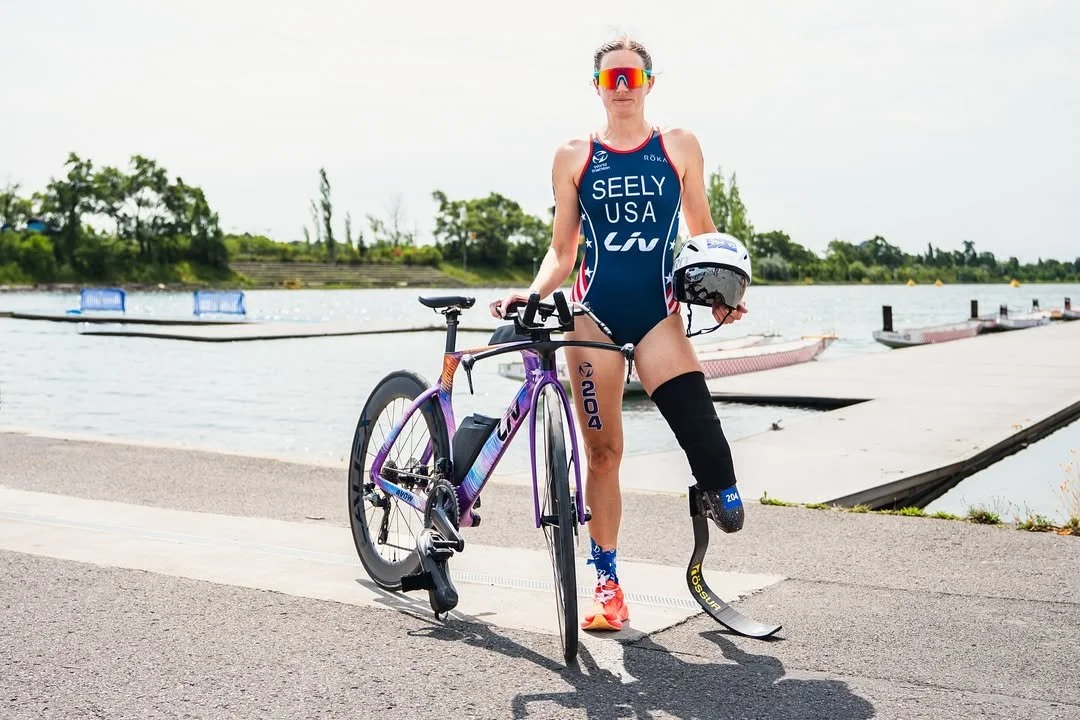
Doctors said a feeding tube would end her career. This world champion triathlete proved them spectacularly wrong.
WORDS // DANIELLA DOUGHAN
Allysa Seely didn’t set out to become one of the world’s top Paralympians. In fact, she almost walked away from sport altogether. Growing up, Allysa was always moving – dancing, running, pushing her body in ways that felt natural and joyful. But by the time she reached college, that joy had started to disappear.
The pressure of high-volume training, constant running and the “lighter is better” mentality of many coaches of the time left her burnt out.
“I was struggling to get in enough calories and struggling to fuel my runs,” she says, from her home in the US. “I needed to find fun in sport again.”
So, during her freshman year of college, Allysa tried something new: triathlon. The mix of swimming, cycling and running felt refreshing. The variety, the challenge and the camaraderie reignited something she thought she’d lost.
“I absolutely fell in love with the challenge,” she says. “It was fun again, and that was something I really needed at that time. Never did I imagine it would turn into what it has. It’s been a crazy journey that’s for sure.”
When answers didn’t come
Not long after her first triathlon, Allysa began getting sick. She slept constantly, struggled to keep up with school and bounced between doctors looking for answers. Some symptoms had been present since childhood, others presented in her teenage years. They were all repeatedly dismissed.
“I was told, as a young female, that it was anxiety or that I must have an eating disorder – because every teen dancer and runner apparently has one,” she says.
No one was really listening. Meanwhile, her health continued to deteriorate.
In 2010, after years of unexplained symptoms and unintentional weight fluctuations, Allysa was diagnosed with a brain and spinal malformation and gastroparesis, a condition that affects the stomach’s ability to empty properly. During off-seasons, when she wasn’t training as intensely, she could regain weight. Once training ramped up, she couldn’t eat enough to meet the demands of her sport.
“It was limiting me physically and mentally,” she says. “Being underfuelled affects everything.”
That same year, Allysa underwent major brain and spinal surgery, hoping it would ease some of the secondary symptoms. While the surgery helped in some ways, her gastroparesis continued to worsen and, in 2013, complications in her left foot resulted in a below-the-knee amputation.
Hospital admissions became frequent, driven by malnutrition and dehydration. By 2017, Allysa’s health reached a critical point. She weighed just 72 pounds (just under 33 kilos). Doctors told her she needed a feeding tube and that she would never be a competitive athlete again.
“That didn’t feel right to me,” she says.
At the time, Allysa has started working with a sports dietitian who would become one of her greatest advocates for continuing sport.
“My sports dietitian was willing to say, ‘Let’s try. We will fail if we have to, before giving in.’” Allysa recalls.
That moment changed everything.
Together, using medical nutrition as a tool – rather than a limitation – they rebuilt Allysa’s nutrition from the ground up. Over the following years, Allysa learned how to fuel her body through tube-feeding, adapting her training and recovery around it.
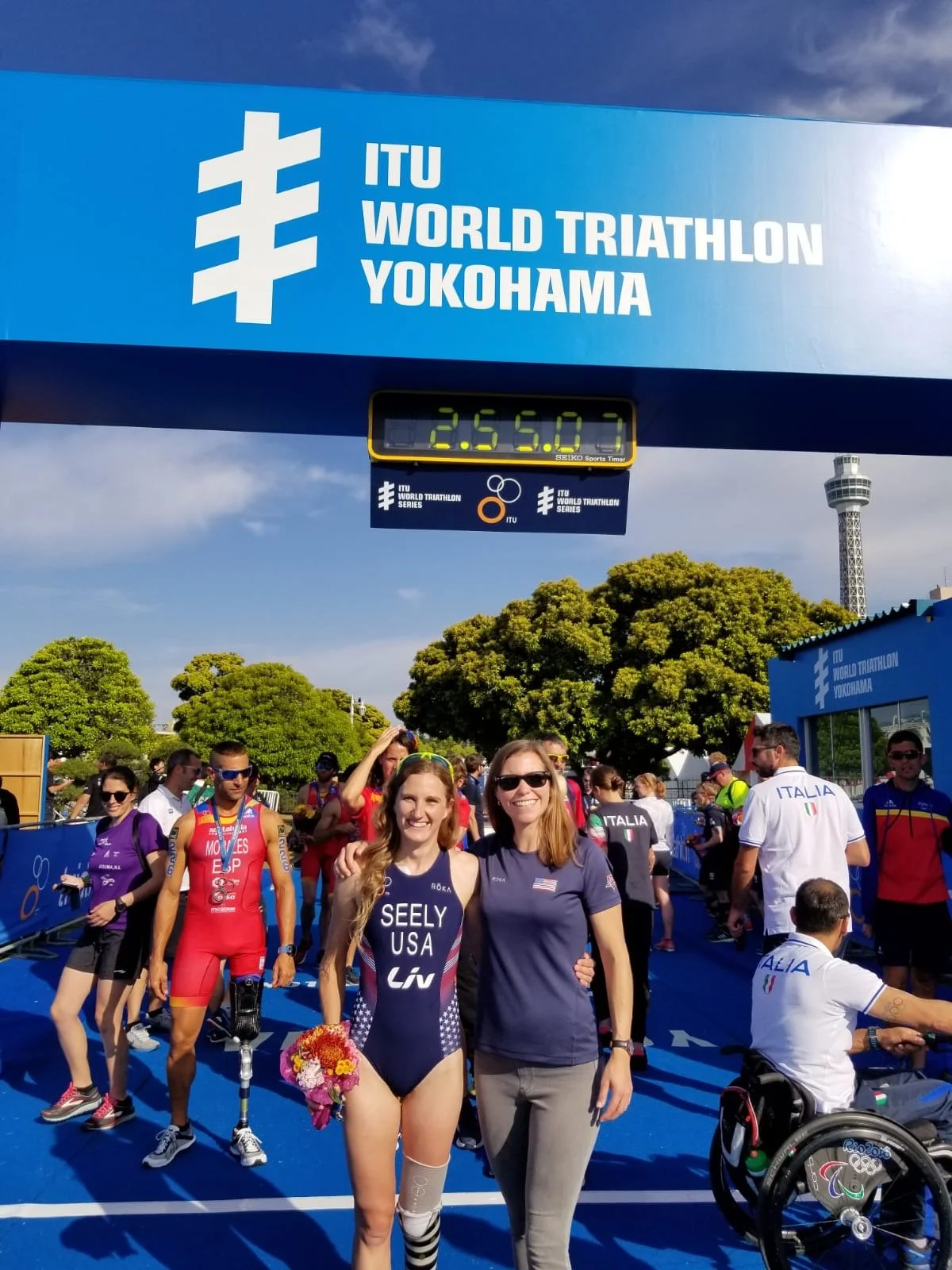
“I earned my second medal in Tokyo with her assistance and learnt so much about medical nutrition and how to utilise it to fuel my body,” says Allysa. “I’ve been competing ever since and I love what I do.”
Training with tubes
Today, Allysa uses a gastro-jejunal (GJ) tube and has previously had separate gastric and jejunal tubes. She also uses a port for fluids and total parenteral nutrition (TPN) when needed. Her nutrition plan is detailed, dynamic and essential to her success as an elite athlete.
“There’s nothing standard about it,” she says. “Nutrition support is a huge part of why I’ve been able to stay active.”
In the early years, she met weekly with her dietitian and planned her days down to the hour – how many millilitres, how long she’d be hooked up, when she could train. Some feeds run overnight, others during the day.
She doesn’t run outdoors during feeds, but will use TPN or fluids while treadmill running.
“If I’m cycling I will have a fanny pack and it will have tube-feeds,” says Allysa. “Then I use the Mobility+ feeding system when I’m cycling or out and about. This lets me get the calories I need and still do what I love.”
Her approach to nutrition is deliberate. Allysa sought out food-based formulas and eventually landed on peptide-based options that worked for her body.
“I was initially using a formula and was disappointed - my body is my goal and my job, and doctors wanted me to feed it with processed ingredients?” she says.
“I knew that wouldn't work for me. I started looking for food -based formulas and I found a few and tried a few different ones before I found the one that works for me.
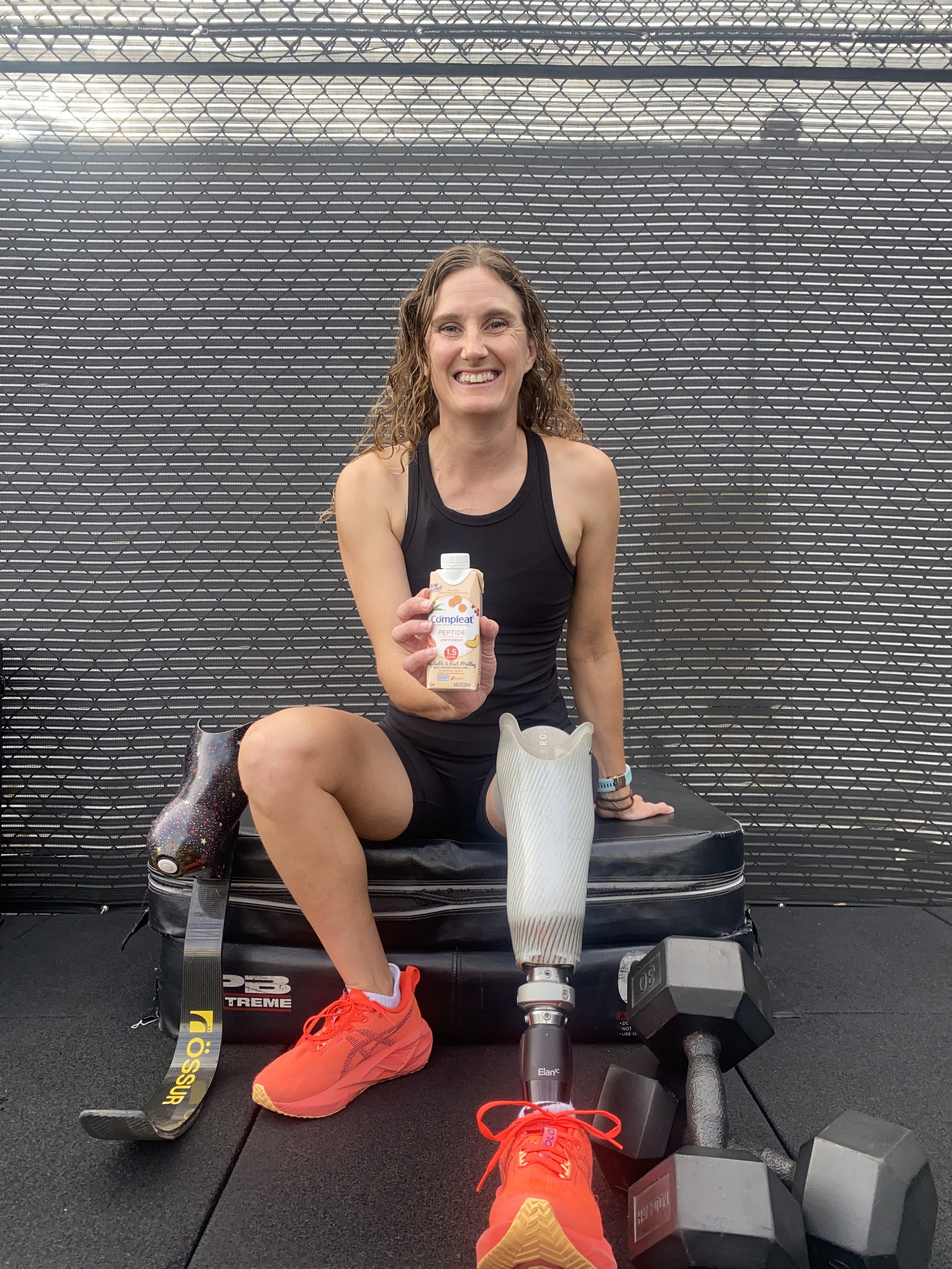
“I now use Compleat organic peptide. I knew I wanted a real-food based diet and, shortly after starting tube-feeds, it became clear that blended food alone wasn’t going to be enough. It needed to be peptide based.”
Back on the world stage
Allysa’s determination is something she attributes, in part, to being “one of the most stubborn people in the world”.
After her first tube placement, she experienced severe complications, undergoing 13 surgeries in just six weeks. On her final post-op check, she asked her surgeon what her limitations were.
“He said, ‘You can do whatever you can tolerate,’” she says, laughing. “That’s terrible advice for someone like me.”
Five weeks later, she was on the start line at the World Championships in the Netherlands, and finished second.
“I came out of the swim in tears because it hurt so badly,” she says. “But after that, it got better.”
Her achievements since then include multiple Paralympic medals including gold in Tokyo. Now, she has her sights firmly set on competing in triathlon in LA 2028, which she hopes will be her final Games.
“The run part is still my favourite,” she says. “It always will be.”
Disability, visibility and rewriting the narrative
Despite her success, Allysa knows that public perception doesn’t always align with reality.
“There are so many misconceptions about what I can and can’t do with my body, or what I should and shouldn't do,” she says.
“The reality is I do have a disability and many times it makes my life incredibly challenging. It requires that I do things in different ways that are more challenging, expensive, and time consuming. That can’t be ignored and I don’t think it should be.”
For Allysa, acknowledging those struggles also means shifting the focus away from the body itself and toward the systems and environments that make everyday life harder.
“What increases the level of people’s disability are the barriers around them. Lack of access to an elevator, lack of access to braille, or discrimination at work because they have to be tube-fed during their shift,” she says.
As well as practical challenges, Allysa speaks about the burden of administration.
“Another huge part of my condition is the number of medical appointments and how many times I’m hospitalised. We shouldn’t ignore that but we also shouldn’t let it control our lives,” she says.
“It’s about creating a balance between ‘I have a disability and that is challenging’ and, also, there are ways to overcome real challenges and work with my body, not against my body, to accomplish what I want to accomplish.
“Being disabled doesn’t make life no longer worth living to the fullest. It’s not all bad. I really want that perception to change. It’s okay to be disabled but it’s not okay to let disability control your entire life.”
Words of wisdom
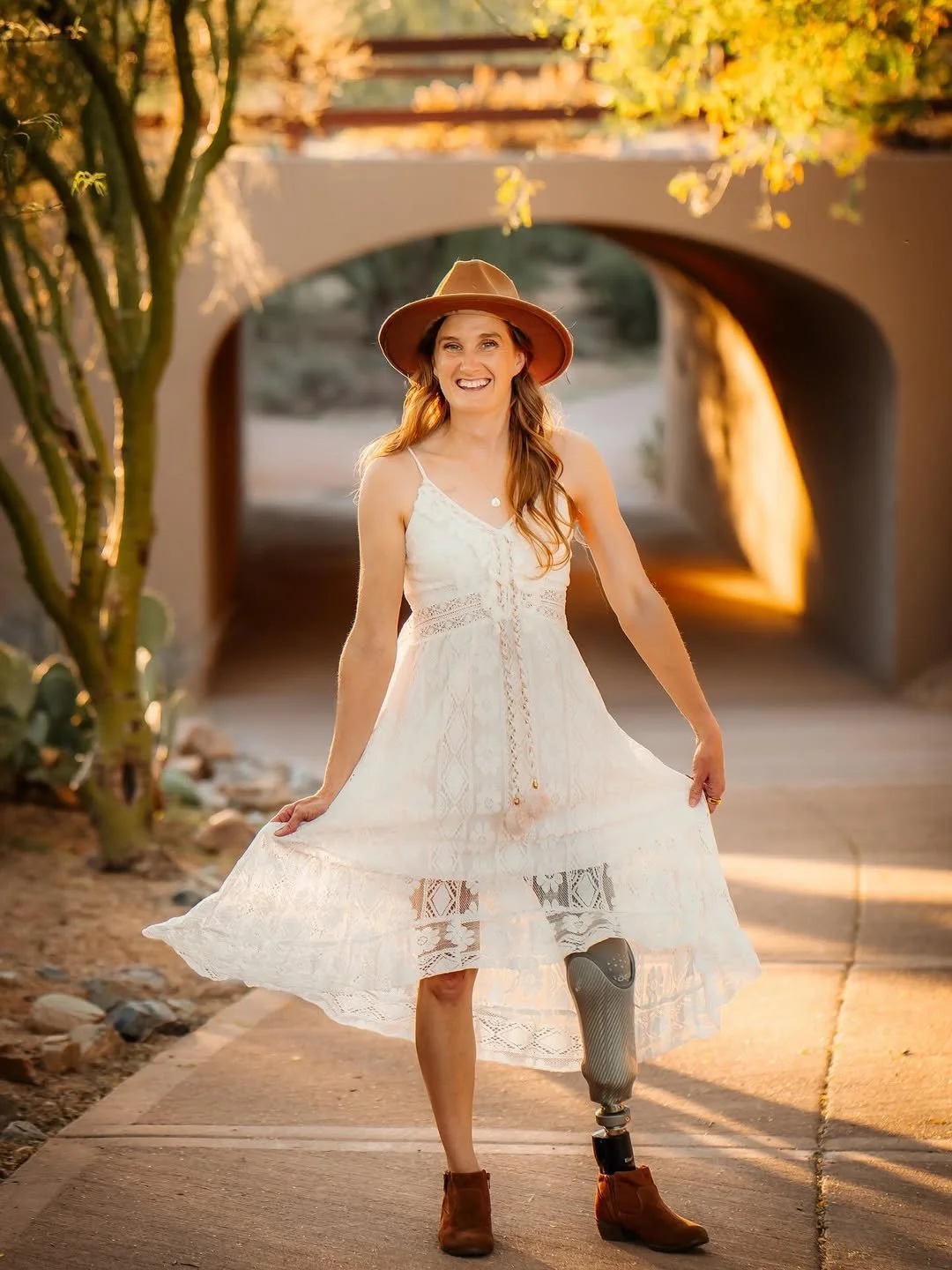
Allysa’s advice to anyone facing a feeding tube or major medical change is simple: don’t panic.
“I think the immediate reaction is fear of the unknown. That a full life is not possible, it’s over,” she says. “And that is simply not true. Almost everything I’ve wanted to do, I have been able to accomplish on a feeding tube: compete as one of the best athletes in the world, travel the world, finish school and advocate.”
Confidence, she believes, is often the antidote to fear. Once you understand what supports you, what makes you feel safe, and how this change can actually benefit your life, it becomes easier to move forward.
“There’s definitely going to be adjustments – and that can be scary,” says Allysa.
“My best advice is, figure out what helps relieve your fear: is it talking about it? Is it having the fear recognised and heard? Is it understanding the why and how? For a lot of people it’s talking to the medical team, or a peer with a feeding tube. For me, I’m a problem solver, so I wanted to know all the information and pieces so I could solve the puzzle.
“It’s about finding what gives you comfort and then adapting – not giving up – and continuing to live your life.”
Advocacy beyond the finish line
Off the racecourse, Allysa is deeply committed to advocacy. She works across sport and medicine to improve care communication, women’s health outcomes and inclusion for athletes with disabilities.
She serves on women’s health task forces, collaborates with medical universities and hospitals, and speaks to organisations about leadership, goal-setting and disability inclusion.
One project especially close to her heart is her work with Girls in Gear, a non-profit dedicated to building confidence in all girls through bike riding.
“The mission is simple,” she says. “No girl is left out – even those with medical and physical needs.”
From adaptive equipment to inclusive coaching, Allysa is helping ensure that physical disability is never a barrier to participation, confidence or joy.
She’s also involved in research focused on disabled athletes and female athletes with complex health needs, with plans to include those who use feeding tubes and TPN.
“My hope is that, one day, no woman will be told her life is over just because she has a disability or a feeding tube.”