
Best in Show
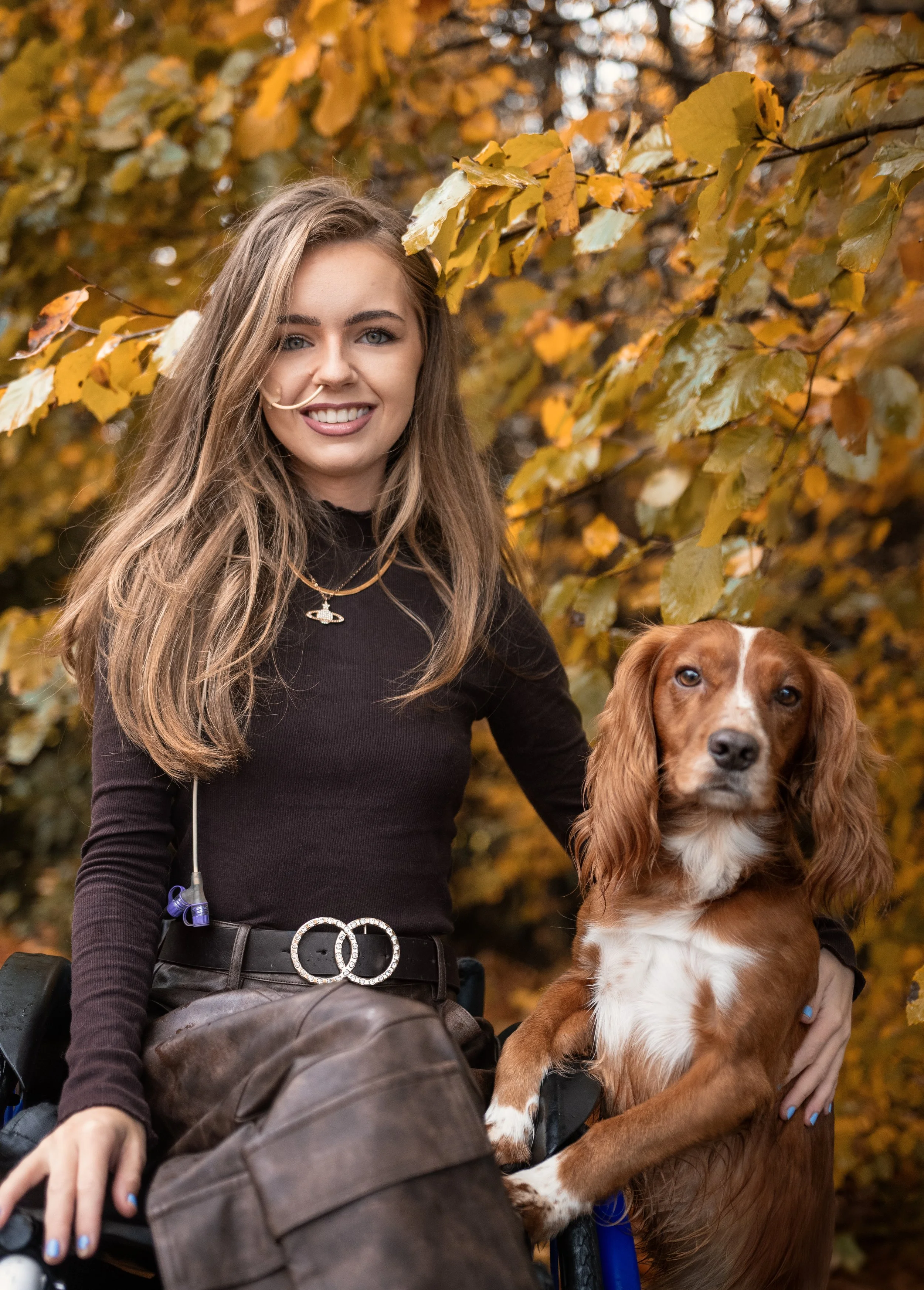
From the brink of death to small-screen stardom, dogs have been a lifeline for this sparkling talent. And she says the same about her feeding tube. UK pet expert and television presenter CHLOÉ FULLER tells MELANIE DIMMITT how being disabled has fuelled her rise to fame — and why she’s proudly representing nasoenteric tubes in the media.
Chloé Fuller got her big break on the eve of what she calls “heaven on Earth” — Crufts. The world’s most prestigious dog show has been held annually in the UK since a young man, Charles Cruft, turned his heel on the family jewellery business to follow canine pursuits, debuting the celebrated event in 1891.
Well over a century later, 20-year-old Chloé – a lifelong Crufts fan – was taking part in the festivities for the first time. In 2019 she and her mum, Nicola, were in Birmingham, gearing up for four days of obedience contests, breed judging and dog-and-handler dance routines.
Staying at a nearby hotel, on the night before it all unleashed, the duo visited a local bar. Here, they saw leading broadcast journalist Clare Balding, who covers Crufts for Channel 4.
“And I was like, what do I do?” recalls Chloé from her home in Manchester, snuggled with her assistance-dog springer spaniels Cinnabar and Mr Ted – the latter of whom was by her side in that Birmingham bar when her mum said: “You know what you've got to do. You go over and you say hi.”
They’d come a long way to get here.
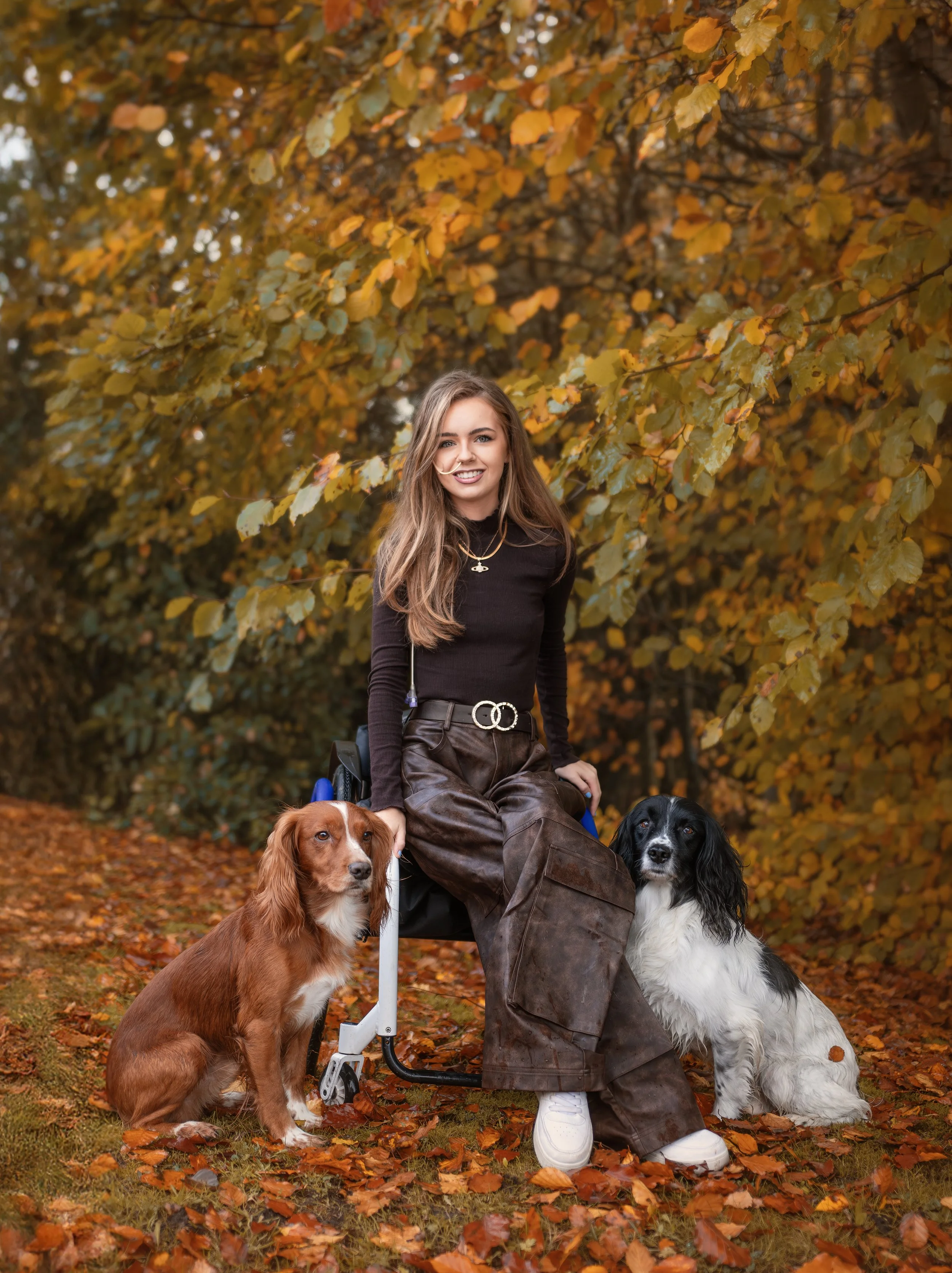
Just six months prior, Chloé had departed a lengthy hospital stay with her first nasojejunal (NJ) tube. This meant she could receive nutrition directly into her jejunum – part of her small intestine – bypassing a stomach which had caused her lifelong pain.
At age 13, Chloé was diagnosed with Ehlers-Danlos syndrome, postural orthostatic tachycardia syndrome (POTS) and several other conditions. By the time she was 16, she was a fulltime wheelchair user. By the time she received her feeding tube, she had almost entirely lost the ability to eat and was dangerously underweight.
“My stomach had never been great but when it started declining, it happened quickly, over the course of nine months,” says Chloé.
“I was really aware of the fact that I didn't have weight to lose. So I put a lot of pressure on myself to eat, which would then send me into a flare-up with my stomach, which would then mean that I couldn't eat for four to five days. I was entering into this boom-bust cycle.”
It didn’t help that Chloé is dairy intolerant, ruling out the majority of meal replacement formulas. She’s also allergic to many fruit-based alternatives.
“I had spreadsheet upon spreadsheet of all of the different foods that I could have and I would rank them by calories and try and figure out a way that I can get the most in. It completely and utterly dominated my life,” she recalls.
At the tail end of a three-month hospital admission, placing an NJ tube was a “last-ditch attempt” to turn things around.
“And when I became tube-fed, there really was a sense of relief because I was like, I don’t have to stress anymore," she says. “I no longer had to worry about dying. I no longer had to worry about the pressure to eat and, suddenly, I had so much more energy than I’d had in years.”
Chloé now has Nutrison Soya formula through her tube and eats small meals orally. Roast broccoli is her favourite but she suffers after eating it. Her best bet is sugary tea and biscuits.
“It’s an abysmal, appalling diet but it’s the safest way that I can keep myself on a level,” she says.
Once, while waiting for a broken tube to be replaced, Chloé existed on sweet brews and bikkies for a month. Her medical care hasn’t always met the mark but, otherwise, she says tube-feeding “has only been positive”.
“When I was in hospital, when the tube was placed, it very much felt like a turning point in my life because I had this appreciation of how close to the edge I came. And I came out with a ‘fuck it’ attitude where I would basically just be like, you know what? I should just go and do the things I love. I should just go and do them.”
Which is how Chloé found herself at Crufts. And, on that fateful evening, steering her wheelchair toward a famous television presenter.
“Shaking like a leaf I went over and introduced myself. Like, ‘hi, my name is Chloé. I just want to say I'm such a huge fan of Crufts and it's amazing to meet you. I'm coming tomorrow for the first time ever. This is my assistance dog, Mr Ted, and he's given me my life back’. We got chatting and Clare Balding basically said, ‘I’m going to have you on TV tomorrow’.”
Chloé and Mr Ted joined Clare in the studio, telling the story of how her canine companion helped her find new purpose in assistance-dog training and studying pet nutrition. That interview was televised to millions of worldwide viewers, with Chloe showcasing a level of on-screen confidence on par with seasoned broadcasters.
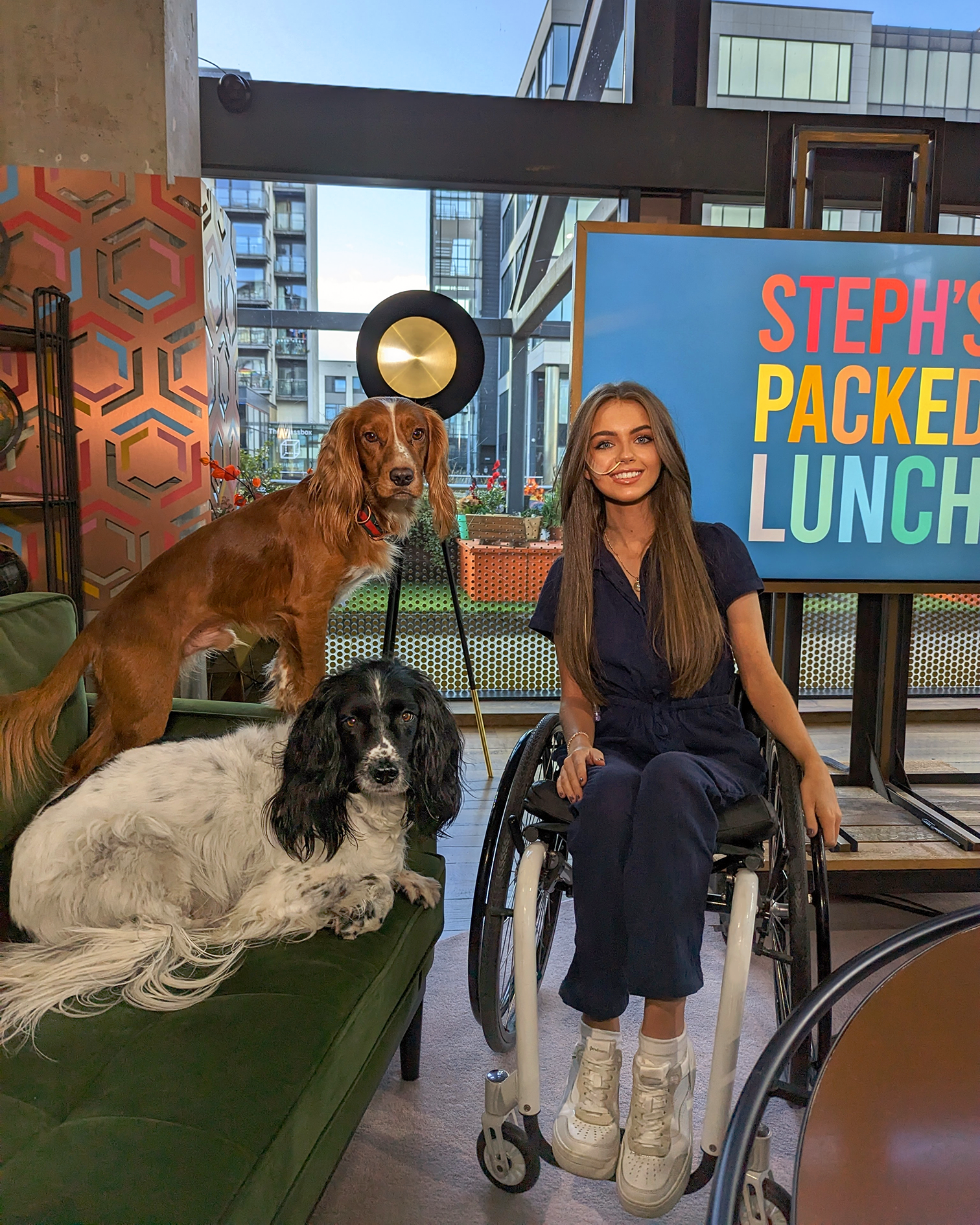
An extensive list of canine health qualifications and a propensity to “yap”, as she puts it, have since seen her presenting as a pet expert and advocate on programs including ITV’s This Morning and BBC’s The One Show. She also tours her own act, The Super Spaniels, to dog shows across the country.
Six years after her Crufts debut, this interview takes place over Zoom and features cameos from Mr Ted, Cinnabar and mum Nicola who, at one point, discreetly takes Chloé’s empty mug and hands her a fresh cup of tea.
Have you always been a dog person?
Always. When I was younger I was surrounded by dogs and throughout my entire life they’ve played pivotal roles for me. I grew up with a springer spaniel before Mr Ted and then, when I became disabled and realised that I wanted to train my own assistance dog, I felt like spaniels had everything I needed.
They’re not necessarily the most typical choice for an assistance dog, but I found you, and you were absolutely perfect for it — weren’t you, Mr Ted?
He’s also fantastic in a television studio – much like his owner. Where does your confidence come from?
I was very nerdy and did great in school, but my reports all said the same thing: “If Chloé could just know when it was and wasn’t appropriate to talk, that would be great.” And I always played the narrator in the school plays, that was never up for debate.
From the age of three I was having full-blown conversations with my mum. She’s a single parent and I was the only person she had, so she used to talk to me like an adult. We had regular back-and-forth adult conversations.
I also grew up in a golf club that we ran and lived in. So if you think about the demographic of a golf club, it’s rich middle-to-upper-class white men who all think that their opinion is the most important opinion. These men felt that children should be seen and not heard – and I certainly wasn't having that at the age of five.
So you’ve always had this confidence…
When I became disabled, I couldn't find it – and the tube was the catalyst for it coming back. Because the thing that I found the hardest to contend with after I became disabled was that everybody stared.
As a young, seemingly healthy looking girl in a wheelchair it just felt like the world was staring. When I got an assistance dog, they stared even more. Add the tube, everybody looks at me – that's not me being paranoid, that is a fact of life.
And so my brain went, well, they’re already staring so I might as well give them a reason to. And now, if I do TV or events or anything like that, I'm already used to people staring. So in the weirdest way, being disabled made it so much easier. And if I get recognised – which does happen – I'm pleasantly surprised that that's why they were looking.
Have you ever been encouraged to transition to a less-visible feeding tube?
My consultant has consistently wanted me to have surgery to have one placed in my abdomen. And for many different reasons, I don’t want that. His only reason is that, “surely a young pretty thing like you who works in TV doesn't want it on her face”.
Well that’s horrendous of him.
I’m ballsy enough that I heard that and I went, wow, what an arsehole. What upsets me is the other young women who might go in there and be self-conscious about it. They need their doctors to go, “it’s giving you life, it’s barely noticeable, you still look great, it doesn't have any impact”. They should be championing what is best for your care.
The fact that the only reason my doctor can advocate for me to have major abdominal surgery is the aesthetic of my face – while I have a health condition which means that I don’t heal and I’m more susceptible to infections – is appalling.
Aside from the health risks, what are the other reasons you're sticking with a nasoenteric tube?
One of the things that I like about having a visible tube is that I don’t get the option of feeling like I should hide it. It's there and I own it. I've even joked with people that if I go on a night out, should I wrap a necklace around it and decorate it? Why not? If it was hidden underneath clothes, for me, I'd feel like it was something to hide. And I don’t like that.
Another reason is that my nasal tube works fine. I’m lucky, right? I don’t have problems with it. I find the placements totally fine if I have a skilled radiographer. I know a lot of people who find that it blocks and kinks quite regularly but for me, I usually get six to 18 months out of the feeding tubes.
Ultimately, if the only justification that my consultant has is to get it off my face, it’s not even a conversation to have. That’s my personal experience – and if someone else made a different decision based on their experiences, I would be a champion in their corner. What is most important is that you make the right call for you. That’s all that matters.
Like you mentioned, some people could be self-conscious about having a feeding-tube on their face. How do you feel about it?
In all honesty, I don’t care that it’s on my face. I don’t have a feeling about it.
I did an absolutely fascinating exercise once where I took a photo of myself and I photoshopped the tube out and sent it to my family and friends asking, “what do you guys think of this photo of me?”
All of them were like, “oh, that's such a lovely photo”. None of them realised and I had to say, “guys, there’s no tube”. And they were like… “Holy shit, there’s no tube!”
The thing is, it’s part of your face. It’s like a nose piercing, it’s like glasses. Have you ever had a family member who wears glasses every single day and then they take the glasses off and you’re like, something’s different, but I don’t know what? It’s like that.
So I’m not going to sit here and go “I’m proud to wear it on my face” when it’s just part of my face. But what I am proud of is the fact that it is representation — especially in the media — in a way that I’ve never seen before. I’ve never seen anyone on TV with a nasotube. Never. And I hope that if people have a similar arsehole doctor who makes a comment like that to them, they see me and go, maybe it isn’t so bad.
How did your career progress after that interview at Crufts with Clare Balding?
She said to me afterwards, “you were amazing”. And I was like “oh, no, I just enjoyed chatting with you”. She was like “no, you should pursue TV”. I said “thank you for the encouragement, I really appreciate it, but… how?” And she said, “just don't give up”. And to be honest I didn’t do anything with it. But I took away the fact that somebody who was probably considered one of the most iconic TV presenters in the UK believed in me. I kept that in my back pocket.
Then I went into the world of events and I kept that attitude of, fuck it, what’s the worst that can happen? I devised a show sharing 24 hours in the life of an assistance dog in a 30-minute arena slot and I took it around events. I then posed to those events, “you know, I can also do pet nutrition talks at the show”. So they were getting two lots of content for one.
I got a contract with a show called Dogfest and, unbeknownst to me, a TV producer had come to one of those events to scout talent. She watched my nutrition talk and she approached me saying, “hey, I think you’re really good and I think this would work really well in our TV show. Have you got much TV experience?”
Realising that this was my one shot, I said “oh yeah, I’ve got loads!” And she was like “amazing!” It was total bullshit. I winged it entirely and did not have a clue what I was doing but I made it happen. I went and did that one TV segment and they thought I did great. So then they called me the next week, and the next week, and suddenly I had a weekly slot on the second-biggest daytime TV show in the UK.
After I’d worked for that TV show for 18 months, I wrote out an entire two-hour episode with all different disabled talent. But they didn’t need to talk about their disability – they could be there as an expert in their own right, like what I do. I sent it to the producer thinking they’d say no, but they said, “knock yourself out, kiddo, do it!” and we made it happen. That was one of my proudest moments.
Pretty cool that this all came about because your mum made you go and chat to someone in a bar.
None of it would happen without her. Mum’s great at making me look like it’s all me. She’ll very slyly pass me something that makes me go, oh yeah, I’ve not drunk anything or I’ve not pissed or I’ve not flushed my tube. There will be so many things that I’ve forgotten to do because I’ll be so focused on work. And she’s the one ferrying me around the country, because I can’t yet drive.
Any TV stuff, any event, she’s always alongside me. It’s a massive help for me, but I also think that both of us always have in the back of our minds that one year where everything went wrong and we spent more time in hospital than we spent out of it. And it just seemed like there was no light at the end of the tunnel.
It really felt, for that period of time, that it was us against the world. So now, the most beautiful thing for me is not only to be able to have her by my side, but also that she's had so many cool experiences she would never have had without me and the career that I've built.
I think there’s always guilt, as a disabled person, about what you put your parents through. And while I can never take that away, I can now sit there and go, yeah, I did put you through hell, but you also have done some really cool shit because of me. That's been the most amazing thing to be able to give back to her.
You’re an incredible family unit. Have you got any siblings?
Yeah I do. I have two siblings and they’re both younger than me. One is called Jack and he’s 20 and then the youngest is Luca. He’s autistic and there are lots of things that he really struggles with. And through the experiences that me and my mum have had, we are now in a better position to be a champion for him. I love the fact that we can present that united front for him.
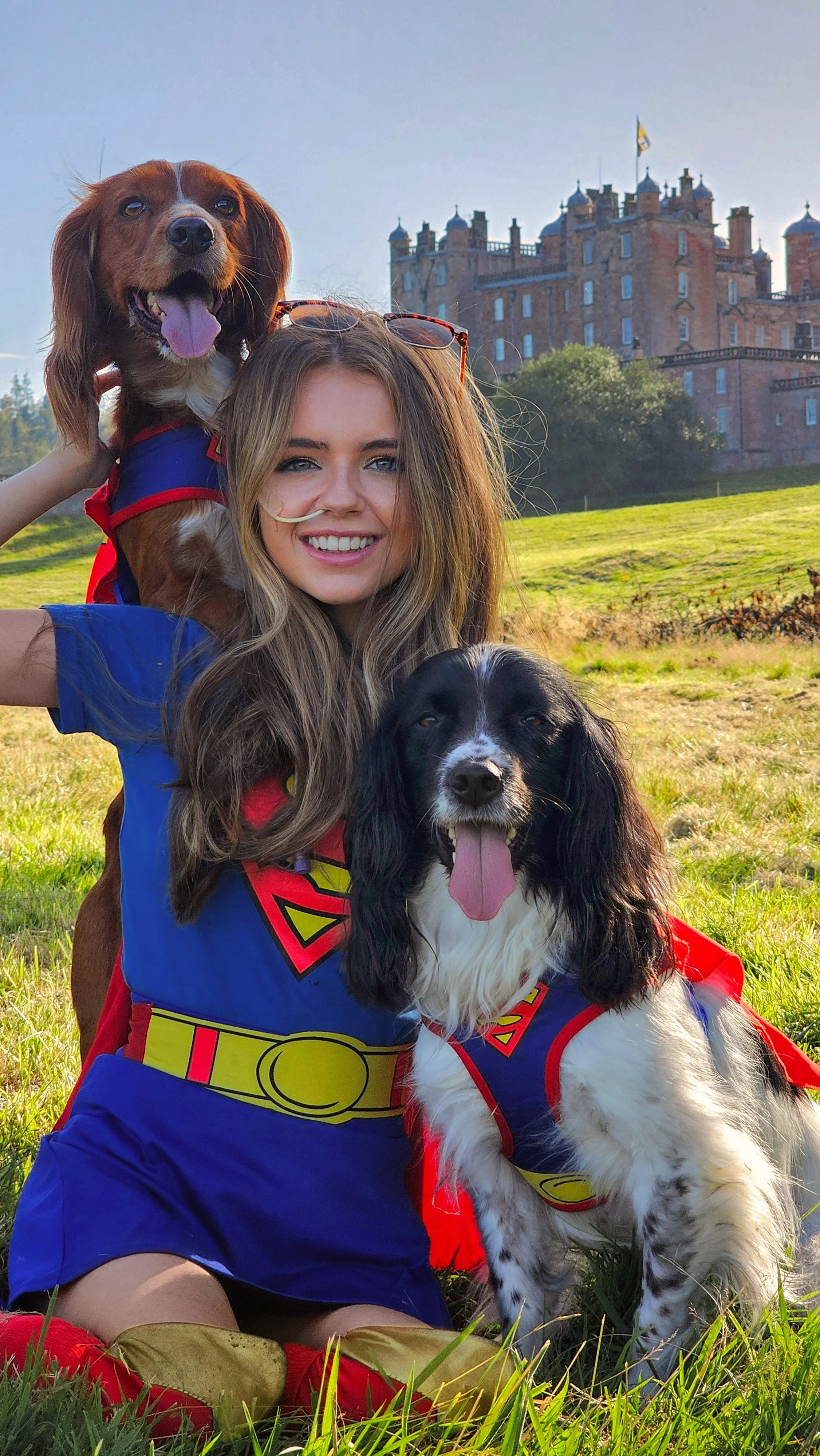
He’s not got a tube and he’s not in a wheelchair, but sometimes he feels like he’s weird. And I’m like: “Buddy, you think you’re weird? Take a look at me. I prance around in a field wearing a Superwoman costume with a tube on my face with a wheelchair that looks like a tank and two dogs that wear Superman costumes. You ain’t weird, kiddo. If anybody’s weird out of the pair of us, it’s me. And I own that shit. I think I look cool. So you don't need to worry.”
You’re an advocate at home — and also to the world. What do you wish everyone knew about feeding tubes?
Number one, I can still eat. Don’t exclude me. Let me make that decision. Some days I’m in a right foul mood and I don’t want to go out for a meal. But most of the time I’m like, “yeah, I'd love to”. And I’ll have a small little bite to eat and enjoy the atmosphere. I’ll enjoy talking with everybody. I might have a cocktail because, thankfully, I’ve never had problems with fluids. So that’s number one: I can still eat, don’t exclude me.
And number two – which I would say both to the general public and also people who are facing a feeding tube – is that it is so far from the end of the world. For me, it was the beginning of a whole new one. And in the best possible way.