
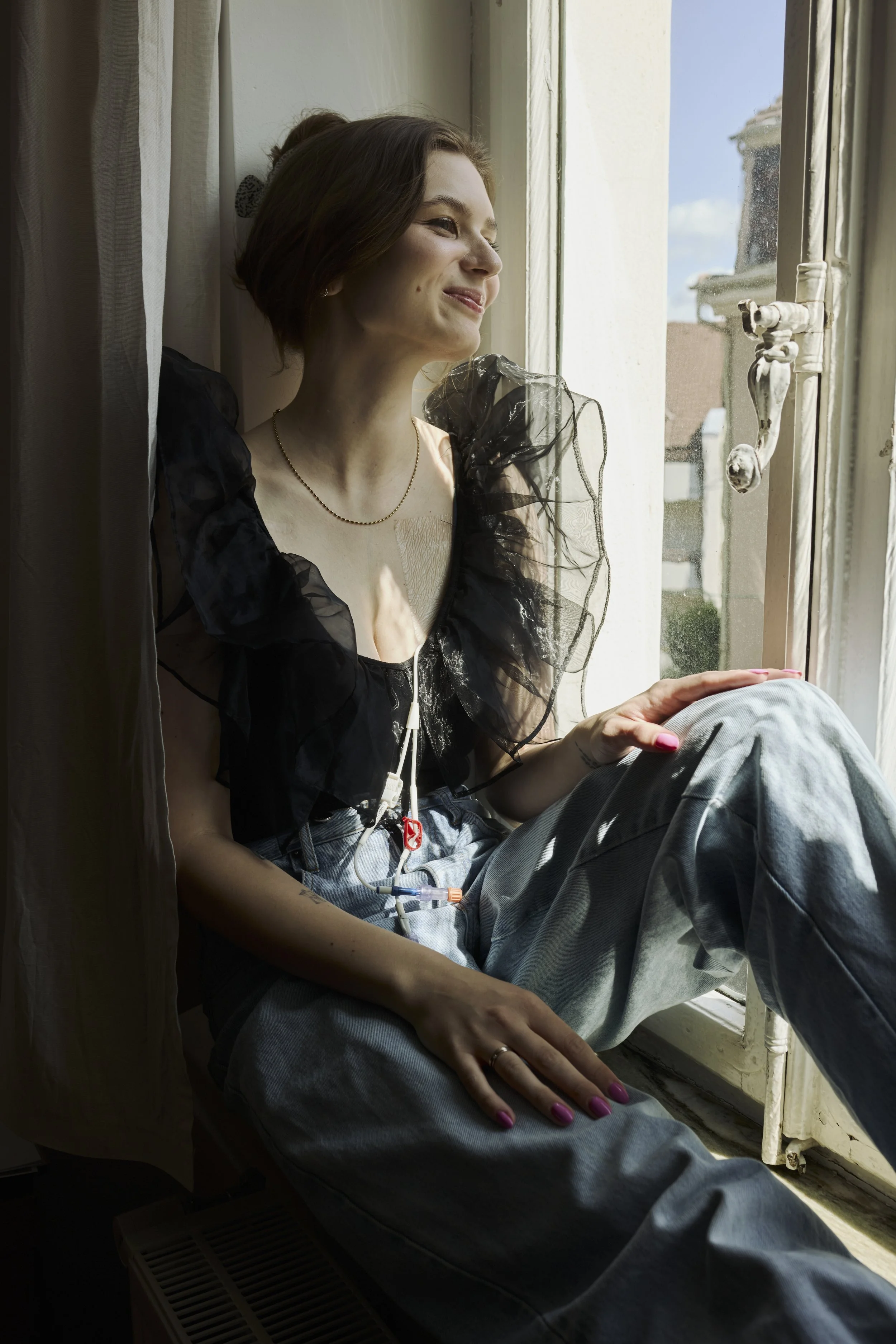
Photography by Sarah Aurora Kaufmann
She’s lived with pain for as long as she can remember. But for this seamstress and storyteller, hope springs eternal.
It’s watermelon season when Anna Dorina dials in from Wuppertal, a German city known for its century-old suspension railway, the Schwebebahn, which hangs from its tracks like a bat.
“It’s like a train that’s flying in the air,” says Anna. “It’s cool, but I get so nauseous when I’m on the Schwebebahn.”
Watermelons also make her feel sick. But, as is her approach to living with conditions including Hypermobile Ehlers-Danlos syndrome (hEDS), gastroparesis and postural orthostatic tachycardia syndrome (POTS), Anna endures the bad to enjoy the good.
“I love to eat watermelon and I’m ignoring that it’s going to hurt,” she says. “It gives me horrible symptoms, but it’s pretty hard not to eat the stuff you love.”
The 26-year-old applies the same attitude to her daily coffee — “because coffee is a must, even if my stomach doesn’t like it” — but not everything she loves comes at a cost.
Six years ago she married her summer-camp sweetheart, Johannes, and the pair share their home with a golden, mixed-breed pup named Mogli.
Anna’s family has supported her through medical challenges they first became aware of when she was three. Eating food has always caused her pain and, for many years, this pain was disregarded by medical professionals.
“It was always like, ‘oh, it’s growing pain’ or ‘it’s psychosomatic’ and every answer you could imagine,” she says.
At five, Anna was tested for Ehlers-Danlos syndrome (EDS) and told she didn’t have it. As a child she struggled to breathe while playing sports and, at 13, she was diagnosed with coeliac disease. Anna’s symptoms worsened as she reached her 20s, “right around the time I got married”, she says.
“Johannes and I were the first people to leave our wedding because of my back pain — and that was such a big thing for me. I decided then that I didn’t want to talk to any more doctors. I was going to research this by myself because nobody was going to believe me.”
Anna kept pushing. At 21, the same doctors who told her she didn’t have EDS delivered her official diagnosis of hEDS, soon followed by gastroparesis and POTS.
“In a very short time I got so many answers I’d been waiting for my whole life, all while asking myself, am I just crazy? Is it so bad? Does everybody get pain when they eat food? I wasn’t sure of myself after all these dismissive experiences I’d had with doctors.”
No one in Wuppertal would treat her gastroparesis. One doctor, however, pointed out that it wasn’t just her stomach — her whole digestive system was affected.
“He referred me to a special clinic in Germany — it’s the only clinic in Germany, to be honest, that is able to treat stuff like this.”
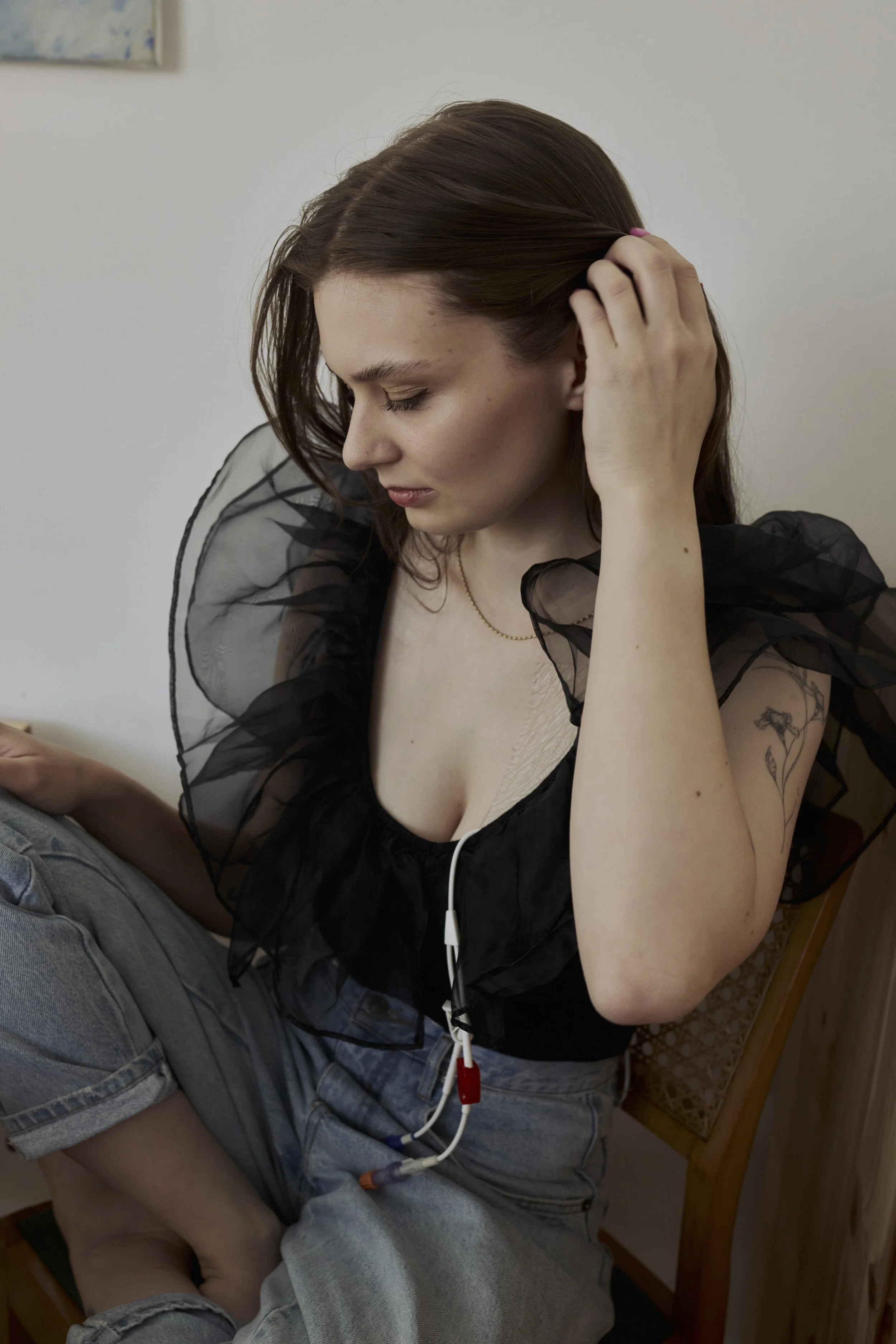
A five-hour drive from her home, here is where Anna would receive a nasojejunal (NJ) feeding tube and, before long, a gastro-jejunal (GJ) tube.
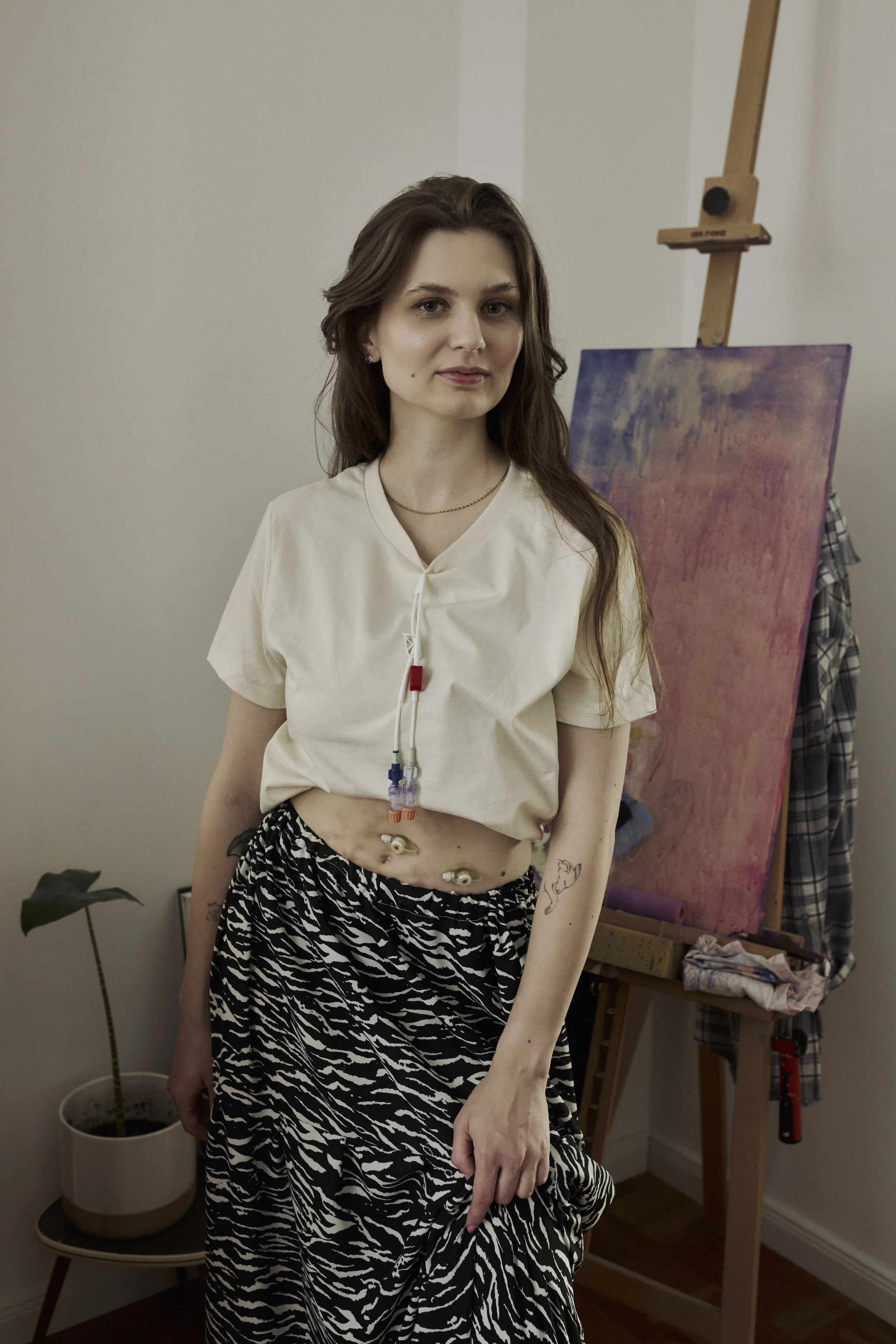
After switching to a button-style tube, her J port repeatedly migrated into her stomach, so two separate feeding tubes — a gastrostomy (G) for her stomach and jejunal (J) tube for her jejunum — were placed.
Eventually, even with feeding tubes, Anna wasn’t able to get sufficient nutrition. Her doctors placed a central line so she could receive the majority of her intake intravenously, through total parenteral nutrition (TPN), which carries a significant risk of sepsis.
“My small intestines are a little bit dramatic and won’t tolerate the internal feeding, so that’s a bit disappointing,” she says. “I would love to be only tube-fed because it’s so much easier and much more risk-free.”
All of this — from her hEDS diagnosis to starting TPN — happened over three years. And it landed her in unfamiliar territory.
“In Germany, most people don’t know stuff like this even exists,” she says. “If you look at feeding-tube awareness, you see so many social media posts but they’re all from English-speaking people. There is so little German stuff.”
Anna is changing this. Across TikTok and Instagram she shares candid moments and musings from her life with chronic illness. She also showcases her creations – beautiful hand-sewn accessories, many designed to accompany feeding tubes, which she sells through her Etsy store.
“The idea of my shop started right after I got my feeding tube,” she says.
“I was in the hospital with another girl who got all the same stuff about one week ahead of me, so we went through the same thing and it was great to have her beside me.”
One night in hospital, while scrolling their phones, the duo found several online stores selling tube-feeding accessories. But shipping costs to Germany were high.
“So I thought, okay, I love to sew – I’ve been sewing since I was 10 – and I started sewing feeding-tube stuff,” says Anna. “I think it was my coping mechanism at that time. I got a feeding tube and I didn’t know how to handle it, so my way of dealing with it was starting to sew.”
Anna’s social media platforms grew alongside her shop, placing her in the unexpected role of content creator.
“It’s pretty amazing how quickly my life has changed,” she says. And her sense of identity has changed along with it.
“I was able to say ‘I’m a chronically ill and disabled person’ when I got the feeding tube placed. I got many chronic diagnoses before that, but I still considered myself ‘healthy’.”
For a long time, Anna was more comfortable with the English word ‘disabled’ than the German equivalent, ‘behíndert’.
“It’s changing, but when I was a kid, ‘du bist behíndert’ [you are disabled] was hateful stuff you say in school to one another,” she says.
Currently studying early childhood development, Anna is learning about inclusion and, one day, hopes to bring this knowledge and her own experiences to working with disabled children.
“I’m always dreaming of the future — and mostly I dream about the future while ignoring the part that is problematic,” she says.
“When I’m being honest, I know if I want to have my own children someday, for example, it’s going to be pretty medically involved. Or if I want to live in another country, maybe the insurance companies there aren’t going to pay for my food.”
In her home country, the vast majority of Anna’s medical supplies are covered.
“I’m not going broke because I have to pay for IV nutrition — and that’s a very privileged thing that I’m thankful for. But it’s holding me in Germany. I can’t travel to Asia for half a year and go backpacking,” she says.
While many of Anna’s peers are seeing the world and starting families, comparison can be a struggle. One that she felt deeply during a hospital stay, when a close friend called to check in.
“I talked to her about how my pain treatment is pretty intense and she listened to me. Then she told me that she’s pregnant,” Anna recalls.
“I’m so happy for her – I’m so happy for all my healthy friends because they live such amazing lives that I’m invested and interested in. I don’t want to lose them. But sometimes it’s hard, because I see their reality and mine is so different.”
In many ways, though, Anna feels her dreams have come true.
“I always wanted to be married to Johannes,” she says. “I’ve always wanted a dog, someday I want to be a mum and maybe this is going to happen for me. I don’t know yet, so I’m going to be hopeful.”
Having found a happy place in her apartment with Johannes and Mogli — sewing, studying and sharing stigma-shifting content with the world — Anna says that therapy has strengthened her mental health and taught her how to claim a hold on life, illness and all.
“On some days I feel like absolute shit about it and I hate it and I’m crying and I’m angry. And on other days, it doesn’t bother me at all,” she says.
“We can’t decide how we are going to react to things emotionally, so I try to welcome every emotion and be okay with all of the mess behind it.”